Three visions: Sonoma 25 years from now
As a species humans are at a crossroads.
Continuing as we are going, one future could have Sonoma under a couple hundred feet of water when the ice caps melt from global warming. What happens to the real estate values then.
Another future is a scenario of mass starvation with genetically modified terminator technology having escaped out, causing an end to agriculture on this planet.
But, if human beings make a paradigm shift, and ecology is no longer the slave to economy ( both from the same root, meaning household, as in taking care of our household), and we have a new paradigm where ecology is at the heart of all we do, and economy is under that, as the servant: then we could have a bright and sweet future possible.
Here it is:
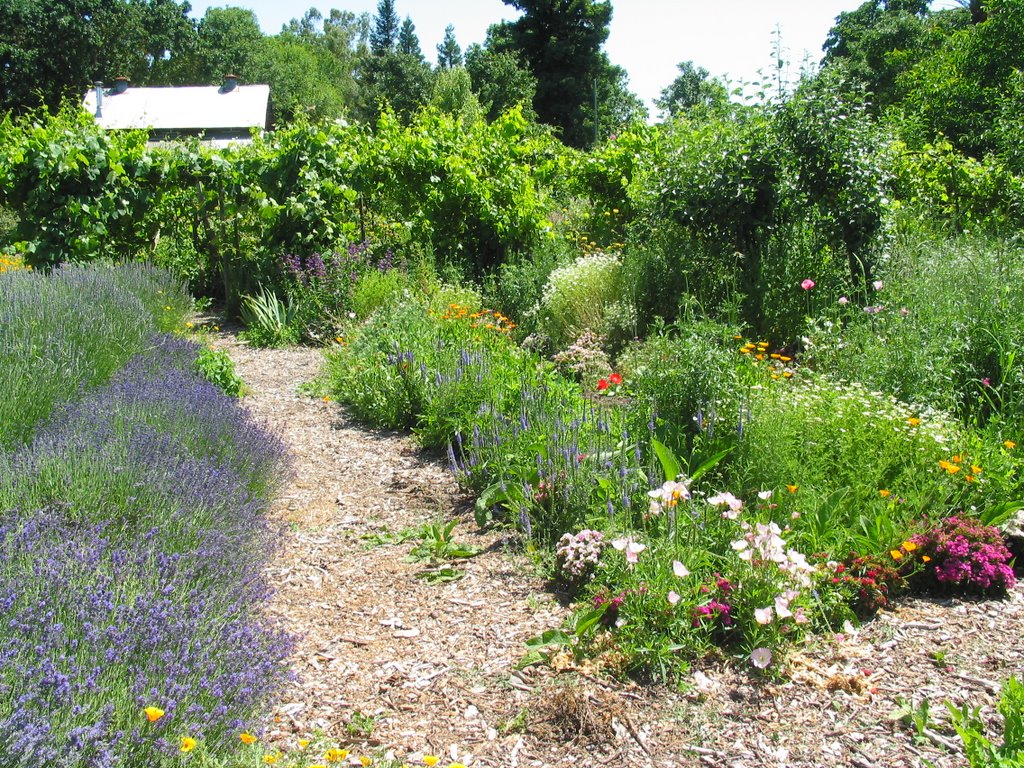
The horse farm is still at the corner of E. 2nd and E. Spain, and the Patch still grows food inside the city limits. The Montini Orchards is thriving and beautiful. The trees at the Garden Park are huge, and hundreds of children continue to thrive and learn because of their connection to that beautiful place.
The Overlook trail connects to a path all around the Valley and this connects to paths to the Bay, to the Ocean and to the Sierras.
A quarter of the streets have no cars on them. They are full of people on skates, skateboards, scooters, bicycles, tricycles, walking. A vast network of bike paths make it safe and easy for a child on a tricycle or bicycle to get anywhere in the city safely.
Visitors come up on light rail, which ends at a terminal where bikes can be rented and solar powered buses can take them anywhere in town. Most of the people in town walk, ride these solar buses, or ride bikes. There are lots and lots of three wheel bikes for the elderly, who have discovered that they don’t want to stay home watching television all day any more, but want to get out at live, talk to people, garden, learn languages, sing songs.
There is an eco village on the Eight Street side of the Garden Park ( which has been renamed the Pauline Bond Garden Park): in it houses are straw bale, cob and rammed earth, all water comes from the sky, all power from the sun.
Throughout the Valley there is eco housing. This Valley, filled with happy healthy people is widely admired and revered as a place with one of the lowest cancer and heart attack rates in the world. People here take happiness and being outside as central to their existence. Community has long ago overtaken the television as “what to do” in our spare time: songs, poetry, music, art, storytelling, hanging out, walking and talking and gardening and trail making and meditating and chanting and laughing together are seen as basic human activities.
We are a beacon to people throughout the world, a destination for ecotourism. We are full of businesses based on how to be happy, how to create the new paradigm, how to live well with less, how to slow down and be a human being instead of a human doing. We care about this central question: what is the meaning of a good life?
We are thinking like a watershed, we are acting like a watershed, we are sustainable. We produce our energy from the sun, we gather our water from the sky, we grown our fruits, vegetables and protein locally.
Within walking distance of everyone in the city is a garden where they can create food organically, to pick each day, put in their mouths and on their tables without having to get into a car.. This is why it’s important not to infill in the sardine fashion: no land = no space to garden and people cut off from the soil are cut off from their soul.
This is a Valley with a soul. Let’s keep it that way, help the paradigm shift humanity needs to make, and enjoy nature and life as our primary aims. As Hafiz said thousands of years ago: “When all our desires are distilled down to one, we will cast just two votes: to love more and to be happy.” Loving nature is part and core of a real happiness.
Thanks one and all. Help the vision come true. I know you will.
Please leave your comments about anything I missed in this essay. This is a vision we all need to help create and nourish. With love.
Chris Elms 996-1437
Labels: possiblities, real ecology