Tuesday, June 29, 2010

111: Thinking without words


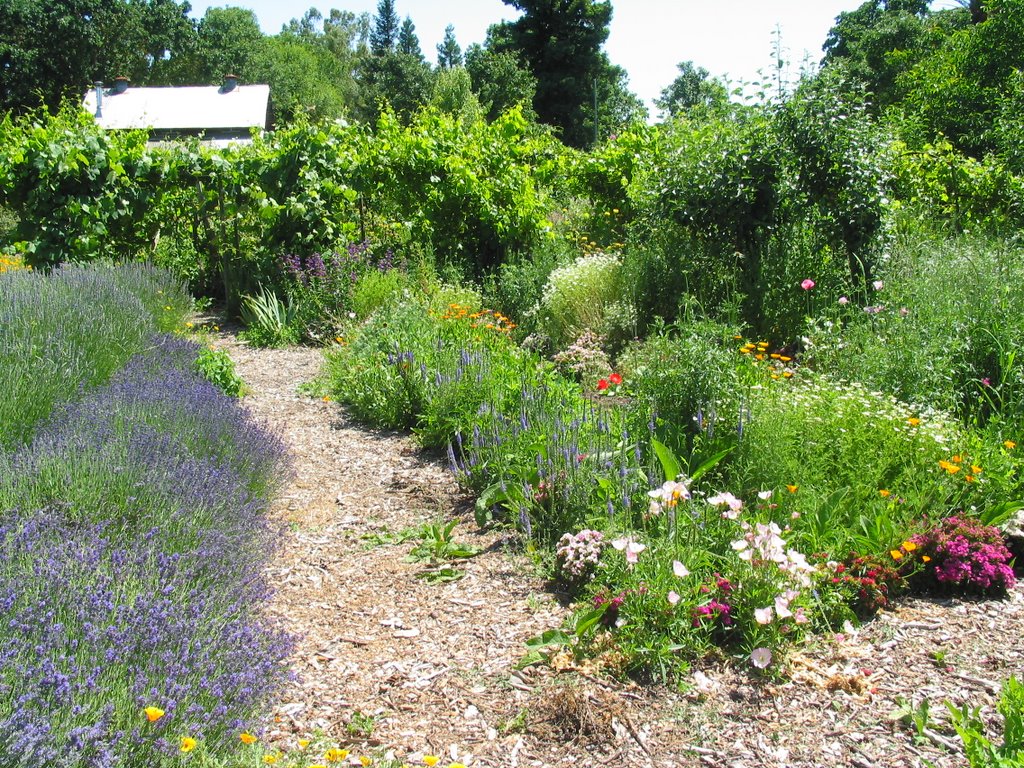
Creating a garden bed by 'sheet mulching"

Not the usual type of “thinking”

What often passes as “thinking” is the spilling over of words in our head, the “chatter” as some call it, “monkey mind” others say, the “yap, yap.” Another way to put it, is “auditory hallucinations.”

Thinking can be very different than this sort of inner talking.

So far, each day, with a noticing of differences, we have been using our brains for real thinking. Today, we’ll notice some more differences, and get more clarity about and feel for thinking without words.

Turn your head easily right four or five times, and then left four or five times. Can you notice a difference one way and the other?

Now turn just to the left with your head, but keep your eyes focused on something in front of you. Notice a difference in how you turn, and in your neck. Go very slowly.

Rest after seven or eight times, and then turn to the left with your eyes and nose together and feel what you feel.

Now turn your nose to the left and back to the center a number of times while turning your eyes in the opposite direction. Go very slowly and clearly notice eyes and neck and breathing and spine. Rest. Turn both left and right in the “normal” way and notice what you notice.

Spend today awaring eyes and neck and right left differences. See what difference rotating your ribs might make. Go slowly, rest a lot, learn.


Labels: , , , , ,

Monday, January 18, 2010

78: Hopping in a New and Non-habitual Way


Hopping and paying attention.

Yes, yes. This is “movement” again, and again, this is the simplest and quickest way to activate real thinking, rather than our usual verbose roundabout not-really thinking “thinking.”

Stand some nice place. Hop your legs wide and back together. Many times.

Rest.

Slowly, combine this hopping with having your arms go out when your legs go to the side and arms back in when your legs come together. Not as many as the usual “many times.”

Rest.

Now, go slowly and figure this out: do the opposite with your arms: when your legs go out, your arms come to your side, when your legs come back together, your arms go out.

Take it easy.

Start over.

Breathe. Get an ease to this.

Let your attention and awareness get more clear.

Rest.

Now try the thinking/ awaring version, like this: as you hop your legs out, have your arms at your side. As you hop your legs back together, let your arms go to the straight out, outside position. So, this is like a reverse jumping jack, feet out, arms in, and then: feet in, arms out.

Go slow.

Catch yourself and smile when you get confused and go back to the “normal” way.

Rest.

Then do it the “normal” way on purpose.

Rest.

And the backwards way, and see if you can do two or three of one way and two or three of the other without stopping completely in between.

Have some fun. Sense your five lines all the rest of today.


Labels: , , ,

Monday, July 07, 2008

Monday ramble: new thinking via new approach

From now on,
an essay will come to slowsonoma.com
each Monday

and an essay to WakeUp-Feldenkrais.blogspot.com
aka Brain Plasticity, Learning, Love and Vitality
on Wednesdays

and an essay
to Tai Chi / Yoga / Health / Weight Loss / Everything
on Fridays

sometimes
the "essay"
will be more a poem
sometimes
an "essay"

sometimes a bunch
of questions

hope you'll come by and visit

here's today's "essay"

THINKING IN A NEW
MODE

Most of us don’t think.

We have a bunch of words running in our heads, often rehearsals of something we plan to say ( and usually don’t.). Sometimes we replay old conversations and give ourselves better lines. Again, sadly, we often spend our mental chatter time complaining about someone, often the person we live with, and hopefully we don’t get around to dumping this load, but even if we don’t, what a waste of a mind.

And then sometimes we think radically true thoughts:
I am alive.
Or,
I have not been aware for the last couple of hours.
Or,
I didn’t need to say what I just said.
Or,
This isn’t working, what else can I try.
Or: This isn’t working, how can I slow down and observe what I’m doing to learn a more useful and effective and easy way to go about this.
Or,
(This close to the first one) I’m going to die someday. Is this really how I want to be using my time and energy and thinking and emotions?
And more.

Later, I’ll have a chapter full of possibly useful or life opening questions to mull in a day, or in a life.

For now, though, I have a proposal.

Let’s go about thinking in a way that the movement activities are actually encouraging and developing: thinking without words.

You’ve had the experience. Suddenly a thought, an answer, an insight just pops into your mind. It’s about something that’s been troubling or fascinating you, but you really haven’t been grinding away at the “issue.” You were doing “something else” when the newness of real thought popped into your mind.


So, today, let’s go about this.

Get a couple of sheets of paper. Look at the first blank page and allow your mind to be as still as possible.

Then, allow yourself to write down four or five words that you would really like to think about. Love. Fear. Freedom.

Many, many more.

Just single words and no more than five.

Write them down, and look at them and follow your breathing and do a little bit of a pelvic clock and have as few words as possible in your mind.


Then, circle one word.

Don’t think. Just pick.

Now, write that word on a new blank piece of paper. Look at it, again, sensing yourself, following your breathing and doing a little arching and folding of your back as you look.

Have an empty mind, as if silence is a vast field of quiet wisdom there just for you to dip into and mine.

Breathe.

Relax.

Don’t think.

Look at the word.

Look away into the distance.

Wiggle side to side.

Get up, walk around. Look at the word.

Turn over the page, forget the word, and go take a walk, again with the walk to be a time to be wordless. Walk and watch. Walk and breathe. Walk and notice your feet touching the ground. Walk and notice light coming in your eyes. Walk and notice sounds coming in your ear.

Come back to your paper. Look at the word once more and start to write for a couple of pages, without stopping, or “thinking,” or punctuating anyway other than what comes easily, about this word.

Let the words and images and ideas just pour out.

Do that until a couple of pages are full.

Take another walk.

Come back, do NOT yet read what you’ve already written, but check in with your intuition and see / feel/ guess if anymore words want to come out. If they do, spill them on out.

Then rest a bit. Or walk.

And then read what you’ve written, and decide if this “thinking” can lead somehow to some wonderful, even if ever so slight, shift or change or improvement in your life.


Labels: , , , , ,

Sunday, July 06, 2008

Independence, learning, life and love

the 4th of July
is over

thank
goodness

i love a parade
and
fireworks
and
a crowd
and a bunch
of people
having a "good time"

and still,
i'm glad it's over

does
4th of July
have something to do
with Freedom
with
Independence
and what would these words mean
in our lives
and in our being
if we didn't just spout
them

now,
around the world
there are repressive regimes
and our is better than most
for most people

and still:
what would real
freedom
mean?

when someone says something
we don't like:
what would freedom be
inside ourselves

when everyone else is doing
something
and wants us to join
and we don't really want to
what would freedom really
look like

when we always put the same
leg in our pants
first
and don't know that

when we go from sitting
to standing
and don't know how we do that

when we hold our breath
hundreds of times
a day
and don't know
that

what would a free life
be
as a being who
moves and thinks
and lives in society


????

those a questions.

what would it be like to have
more questions in our life?

what would it be like
to be okay
with "I don't know"
as a way of being
in a few
or many situations

not clueless,
but curious
really wanting to
understand:
who am I?
what is going on here?
how can I contribute to making it better?

and the great slavery:
the approval and disapproval
of others,
which the Work of Byron Katie
is so useful in
transforming the terror of the situation
into
humor

lot's of ways of
becoming more free.

try desk trainer,
link to right.

try the movement classes coming up,
learn how many more and delightful
ways you could move and be

go into silence
when your "it"
your conditioned
me conditioned
our conditioned
robot person
is screaming to let loose the same
old
same old

lots
of ways

and one
way:
start
to learn
how to think

we all think
we know how
to think
because we have words in
our head

but what would
real thinking,
free thinking,
independent
(which doesn't have to be some stereotypically defiant mode)
thinking
be?

lots of not know
and to be
on the way
to discovering

eh??


Labels: , , ,

Tuesday, June 19, 2007

Exercise that uses variety, big time

I mainly talk about this sort of thing in the wakeup-feldenkrais.blogspot.com,

but it fits with a central theme
about how we are going to save ourselves
from ecological disaster,
which is usually called: saving the earth.

The theme is this:
do less,
do it in smart
and fun and interesting ways.

These videos are in a gym
but they show
what amazing development
you can have when you think along Feldenkrais lines:
variety,
variation,
less effort and more intelligence.

Watch and see what you think:


U tube lazy crazy sports

U tube guy talkng about it


PLEASE BE WELL:


Pleasure
Ease
Awareness
Sensitive Strength
Enjoyment

BE

Waking up to now.
Embracing Change.
Learning to learn.
Loving to move, improve and transform.


CURRENTLY OFFERING THESE CLASSES


"To make the impossible, possible;
to make the possible, easy;
to make the easy, elegant."
Moshe Feldenkrais.


MOVING EASY
MOVING SMART
FOOD FOR BRAIN
BODY
AND
SOUL.

Mondays until June 18
at the
SONOMA BALLET CONSERVATORY
around the corner from the Post Office

Monday June 25,
skipping July 2, and then
Mondays
from July 8 on into August,
at the Field of Dreams,
shady area between upper and lower levels,
(bring a mat or blanket if you don't
want to lie on the grass)
12:30-1:10 PM
Bring a Mat or Blanket
Dressed Comfortably
Be Enthusiastic about Learning, Feeling Better
and Expanding your sense of Enjoyment


Wednesdays
until June 20
OLSEN PARK
(west of W 5th, on bike path,
or on Linda St. just west of W 5th)
10-10:45 PM

Then August 8 on in Olsen
Park at 9 AM.

Cost: sliding scale : $10-20
Seniors (65+) sliding scale: $5-20.
First class: $5-10.


For amazing and transformative
and gentle
one on one lessons,
called
Functional Integration®
see
Individual Lessons

•

Labels: , , ,

Thursday, March 01, 2007

A few good questions: And a Department of Peace

What can we do to help make this world a better place? This is a question that has come to us all. Working to understand our own abilities to change and transform is the most effective step. And also: creating change, real and healing change, out in the world: this is another wonderful challenge.


Last night at the library a wonderful start took place, a meeting of the evolving Sonoma chapter of a movement to create a Department of Peace as a cabinet level department in the U.S. government. This department would be charged with promoting peace locally, reducing gang violence and spousal abuse and the whole mess of frustrated lives spilling out into guns and knives and the wounding and maiming of other human beings. The department would also work throughout the world to bring peaceful solutions to issues that have been endlessly leading to war and conflict.

How it would do the international thing, I have no clear idea. But just the idea of the word
and the actuality of a
Department of Peace,
out in the world,
could be a very positive force.

That it could be of huge use in internal violence, I have no doubt.

For that reason alone I think this is a fine idea.

As I think about what it would take to create world peace I think of two things: happiness and a social system the was set up for equality and basic human dignity, so that clawing one's way to the top, and having more stuff, and getting more profit for the corporation, and having more goodies in one's life were no longer driving forces in the world.

How can that shift take place?

I don't know.

Does that mean that it isn't worth the effort?

No.

As we say in the Feldenkrais work, the real satisfactions in life often come in making the impossible possible ( a frozen shoulder that can move), the possible easy ( now the shoulder moves well), and the easy elegant ( and now the formerly "frozen" shoulder moves better than it ever did).

World Peace is "obviously" Impossible, which means, we have an idea that it's impossible. And as we learn to ask in the Byron Katie Work: Is it true? Is it true that this is impossible?

I don't know.

It better not be.

We don’t have room for the global warming that war is creating, for one thing.

But: we have too many people on the planet.

What if Gurdjieff's creepy idea that some cosmic force eats dead people if not enough people are living lives of consciousness, and so all these wars are the sucking in of the cosmic need for food from a humanity that can't wake up. Can't wake up to the moment. Can't wake up to love.

Can't wake up to being good to the Earth.

And in a way: this is the root of war, this unconsciousness, this lure of the Enemy, that if we just kill enough of The Enemy then The Problem will go away.

Sigh.

This isn't so easy an issue is it?


We have almost every economic system in the world pegged to survive and thrive only by expanding, which is a drive for more stuff and more people, and more potential conflict over land and resources to get and control and use all this stuff.

We have armies and covert operations designed to help corporations keep the goods flowing. We have a whole new system of World Trade agreements that don't even let local farmers grow the kind of food that need for a local people to feed themselves. How can there be peace in this sort of world.

I don't know.

Is this impossible?

I don't know.

I believe, have a hunch, a feeling that humanity is pressing up to the edge of eliminating itself, and that waking up, and learning a new way to live, a way that doesn't demand so much from the planet, will be necessary for us all the survive.

Can people learn growing their own food instead of going to the mall?

Can people learn to be happy with a walk to a neighbors and not have to roar off somewhere in their car?

Can we have kids that are allowed once again to play in and lose themselves in and find comfort and learning in nature?

Can we come to enjoy sharing, and helping others, in real, life shifting ways, not just charity?

Can we learn to do the simple things again: walk, dance, sing, read, make music, make plays, make love?

Can we peacefully create a Department of Peace?

Sure.

And how?

I don't know.

How do we make that shift?

I don't know.

Does that mean we shouldn't try?

Hell no.


Meet the good local people (Terry and Melissa and soon more to sit at the booth, I'm sure) who are starting up our small group to help
this
Department of Peace
at the local at the Farmers' Market on Friday mornings.

Labels: , , , , , , ,

Friday, February 23, 2007

The Meaning of Life

WHAT IS THE MEANING OF LIFE?
Is it true life has a meaning?

I don't know.

Can I absolutely know life has a meaning?

No.

How do I react when I rigidly attach to the thought: "life should have a meaning?"

Worried, annoyed with those who don't get "the" (= my) meaning, rating myself as to living up the "the" (=my) meaning, anxious.

Who would I be without the story: "life should have a meaning?"

Curious.

Alive.

Wondering.

Grateful.

Meaning to discover the meaning for myself, in each moment.


The turn around: Life has no meaning.

Better: thoughts about the meaning of life lead to no meaning, or less under standing of the real meaning.

Life is.

What a gift, eh?

(If this seems a "strange" line of questioning, please enjoy TheWork.com for a brilliant pathway out of emotional bondage and suffering.

Ciao,
Chris


Labels: , , , , ,

Wednesday, January 17, 2007

Love your weeds, Connect to Nature

LOVING YOUR WEEDS
In Northern California, it is our wet season, and though colder than usual just now, in the garden, it’s the time of water and a few winter vegetables, like garlic and kale and chard and endive and onions and some cover crops, like fava beans and field peas and vetch and wheat and rye.

This is the time of year when the so-called “weeds” can thrive, the wild oat grass and the mallow and the dock. This is good.

Weeds are a miracle of life, and they do what plant life does: they take solar energy from the heavens and water and minerals from the earth and turn it into more plant, more green, more “weed,” more biomass. More Life. More oxygen.

To pull out weeds now is to destroy nature’s oxygen and life making purposes. It is to rob your garden of all that plant material that the sun and water and soil would be creating all winter and spring. Someday, and someday soon, an honest gardener will have to stop hauling “stuff” in to the garden, stuff that requires fuel to haul, be it manure or straw or compost. It’s getting time to starting thinking about honestly creating our own biomass to create our own compost.

This could take the form of growth compost radishes for the compost pile, like John Jeavons does. Or, it could take the form of growing all the weeds you possibly can in the winter and then when spring comes and it’s about a month before planting, push them all down, cover them with newspaper, and cover the newspaper with some soil or straw or compost, something to keep it from blowing away. The newspaper will turn all that biomass to soil, rich incredible compost, right there where you want to plant. No tugging out, lugging to the pile and then lugging back to the garden.

In Permaculture , a system of designing your land and garden to imitate nature, extra effort in creating tidiness is usually an affront to natural processes. In the case of weeds, in Permaculture, they are encouraged to grow and then either “sheet mulched,” as explained above, or else eaten by animals that are used within the system for feed or wool or milk. Then the animals are fed on the gains from the sun of the winter.

This is working with nature. This is easier on your work, healthier for the earth and gets us out of this habit of thinking of nature as the enemy, of all thinking of nature as something to fear or conquer or control.


As an aside, but an important one, this fear of and disconnection from nature has very much to do with people’s fear of walking and riding bikes places at night. Yes, yes, it is less safe, and a big part of that is, I think, a cover for a fear of the nighttime, which like fear of dirt, or fear of insects, or fear of weeds, is a disconnection from the non-linear and wild and natural parts of ourselves.

So. Let your weeds grow. Daydream about the seeds you saved last fall and summer. Dig some trenches for irrigation or some swales. What’s a swale? That’s another Permaculture way of cooperating with nature to catch the water in the wet time of year, and it’s another story.

And while you are letting your weeds grow, you might want to take advantage of some of the immense nutrition that you could treat yourself to with mallow and dock, this time of year, and chicory and dandelion coming along soon.

Labels: , ,